South Africa: Tequila's New Competitor, Closes
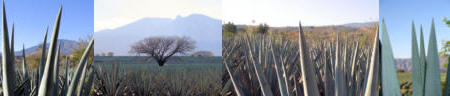
 Agaves - particularly the Mexican blue agave - were introduced into South Africa within
the last century and a half. But how they got there is a tale equivalent
to the origin of the margarita. One story claims it was
Portuguese sailors who brought them in the mid-19th century. A second
relates that agave plants were distributed throughout South Africa in
the early 1900s for both erosion control and as a fodder crop in
droughts. Thousands of plants were planted by many families in the Graaf-Reinet area. A third story says a young girl brought three imported agave plants from Grahamstown in 1938, and planted them on a farm outside Graaff-Reinet.
Still another theory goes that the agave plant was introduced by a
traveller riding from Grahamstown to Cape Town between 1820 and 1830.
Agaves - particularly the Mexican blue agave - were introduced into South Africa within
the last century and a half. But how they got there is a tale equivalent
to the origin of the margarita. One story claims it was
Portuguese sailors who brought them in the mid-19th century. A second
relates that agave plants were distributed throughout South Africa in
the early 1900s for both erosion control and as a fodder crop in
droughts. Thousands of plants were planted by many families in the Graaf-Reinet area. A third story says a young girl brought three imported agave plants from Grahamstown in 1938, and planted them on a farm outside Graaff-Reinet.
Still another theory goes that the agave plant was introduced by a
traveller riding from Grahamstown to Cape Town between 1820 and 1830.
Regardless of which tales is the truth, the agave in South Africa
flourished in the Karoo, and now number in the millions. They were used to make an agave-based
spirit (now called Agava) since 2003, in a venture that lasted until
spring, 2008.
 When the agave shortage hit Mexico
in the mid 1990s, causing havoc in the tequila
industry, local South African businessmen formed Reinet Distillers to produce
their own, home-grown version of tequila. However, while the owners struggled to
unlock Mexico’s tequila-making traditions, they experienced technical problems
in their factory. Reinet Distillers closed without making a single shot of
alcohol.
When the agave shortage hit Mexico
in the mid 1990s, causing havoc in the tequila
industry, local South African businessmen formed Reinet Distillers to produce
their own, home-grown version of tequila. However, while the owners struggled to
unlock Mexico’s tequila-making traditions, they experienced technical problems
in their factory. Reinet Distillers closed without making a single shot of
alcohol.
One of the investors, Keith McLachlan, decided not to give up. He went into
partnership with Swiss-based alcohol distilling and distribution firm Rockwood &
Hines to form Agave Distillers. The factory was revived, and received an
injection of R10-million to continue production.
Because of the
international denomination of origin, no one outside Mexico can make an
agave spirit and call it tequila. That caused some initial upset when
the company was forced to find another description: an agave spirit. However, it does make the claim to be
a "100% blue agave" spirit and producers say it is identical to tequila aside
from the name.
 Agava,
the final product, was triple distilled. Original reports said the gold - the equivalent of
reposado - was aged in a tank with oak staves for three months. Apparently it was
not aged in barrels. However, on SouthAfrica.info, a story said Agava Gold was
matured in oak barrels in Namibia. The barrels were soon going to be brought to the Graaff-Reinet factory to house the whole operation under one roof.
Agava,
the final product, was triple distilled. Original reports said the gold - the equivalent of
reposado - was aged in a tank with oak staves for three months. Apparently it was
not aged in barrels. However, on SouthAfrica.info, a story said Agava Gold was
matured in oak barrels in Namibia. The barrels were soon going to be brought to the Graaff-Reinet factory to house the whole operation under one roof.
There was no equivalent to an añejo.
That distillery produced 1,200 litres a day, considerably less than its capacity
of about 10,000
litres/day. The distillery also become a tourist destination in South
Africa. About 480 hectares of agaves were under cultivation at the plant.
Most of the company's exports were sold as bulk shipments to the
United States, United Kingdom, Australia and France. McLachlan said he hoped to
increase production so he could send more than 60 000 litres a month to
importers. According to company reports, some was even sold to Mexico.
Agava was also available in bottled form. Agave Distillers claimed to be moving between
12,000 and 15,000 cases a month at its peak. The bottled form has been sold in the LCBO, in Canada.
 Agava's
producers claimed their product is as good as, if not better than, tequila.
Whether or not this is true, Agava and other agave spirits made outside Mexico -
generally selling at a lower price point than premium tequilas - might confuse
the consumer and challenge tequila makers in the marketplace for shelf space.
Agava's
producers claimed their product is as good as, if not better than, tequila.
Whether or not this is true, Agava and other agave spirits made outside Mexico -
generally selling at a lower price point than premium tequilas - might confuse
the consumer and challenge tequila makers in the marketplace for shelf space.
Another potential market for the South African agave is agave syrup, or
nectar. This is fast becoming a hot item in both the health food industry and as
a possible replacement for sugar in commercial food production. So far this
market remains untapped by Mexican agave growers, except as a peripheral or
cottage industry. But it was never realized as a market by the South African
firm, either.
Tequila makers and the CRT were well aware of South Africa's pending move
into the agave spirits market. Investors had begun sniffing around looking for
additional financial support and markets well before production began. South
Africans travelled to Jalisco to learn the trade from distillers there. A
trade news story from 1997 reads:
Mexican tequila distillers facing South Africa competition The
Mexican tequila industry, facing possible competition from South Africa, is
pushing for a global recognition of tequila and mezcal as uniquely Mexican
products.
According to the Consejo Regulador del Tequila (CRT), the 15-nation European
Union (EU) has agreed to recognize the property rights of Mexican tequila
manufacturers, but other major consumer nations, such as Taiwan and Japan, have
yet to take the same step.
The EU offered the designation earlier this year in exchange for
a Mexican agreement to accept the same recognition for other European spirits
(see SourceMex, 02/12/97). The EU designation in effect eliminated competition
from "tequila vasco," a spirit distilled in Spain. The EU is the only major
tequila-consuming region that has offered strong protection for Mexican tequila.
According to the CRT, lack of protection elsewhere could allow countries such as
South Africa to begin a "tequila war" with Mexico.
The CRT said South Africa, with climactic conditions that are similar to Mexico,
has vast reserves of the blue agave plant used to produce tequila. According to
some estimates, South Africa has a 39-year supply of the plant, known there as
garingboom.
In contrast, Mexico is expected to face a shortage of agave in the coming years,
which could have a major impact on small and medium-sized tequila distillers in
Mexico. The shortage is caused by overexploitation of agave plants, which has
resulted in excess production of tequila.
"We see the possibility that supplies normally available to small companies will
tighten by 20% to 30%," said CRT director Ramon Gonzalez.
According to Gonzalez, the period of tight agave supplies could last about three
years, or until the next generation of plants is ready for use.
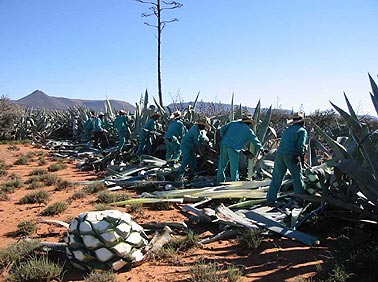 Meanwhile
as the Mexicans wrung their hands, the South African company (originally called Tequila and Mezcal Distillers Ltd.) announced
its plans to construct an agave distillery in the Graaff-Reinet
district near the Cape of Good Hope. The plant was originally scheduled to begin production in the year 2000
with the capacity to manufacture 240,000 liters
of alcohol per month. However, most of the production was intended as an industrial
byproduct, with one-tenth of the output devoted to its pseudo-tequila.
Meanwhile
as the Mexicans wrung their hands, the South African company (originally called Tequila and Mezcal Distillers Ltd.) announced
its plans to construct an agave distillery in the Graaff-Reinet
district near the Cape of Good Hope. The plant was originally scheduled to begin production in the year 2000
with the capacity to manufacture 240,000 liters
of alcohol per month. However, most of the production was intended as an industrial
byproduct, with one-tenth of the output devoted to its pseudo-tequila.
Mexico, facing the possibility of losing global market sales of tequila to South
Africa, responded with a challenge the South African venture, made before the
proper trade authorities in Johannesburg and Geneva. David Ivarra, a
spokesperson for the Mexican Embassy in Johannesburg, said the first step in the
process is for President Ernesto Zedillo's administration to appeal to the South
African government to recognize its responsibilities under global trade rules.
"Under rules of the World Trade Organization, it would be illegal to produce a
beverage in South Africa and call it tequila," Ivarra told the Reuter news
service.
Porfidio, a producer with a colourful history and not a few confrontations
with Mexican authorities to its own name, had apparently changed from making tequila to making
agave spirits, which some sources claimed were allegedly distilled from South African agaves.
South Africa itself may face competition in the agave spirits market in the
next few years. Indian entrepreneurs may soon produce their own agave spirits, most likely to
serve the national rather than export market (see notes on
world culture).
Update, May 2008:
According to a story on Moneyweb, Agave went into
bankruptcy in late February and closed its doors in early March, 2008, following the suicide of one of its directors.
Twenty five employees at the distillery lost their jobs when the plant closed:
Agave Distillers, an unlisted company with a broad, longsuffering shareholder
base, has been placed under provisional liquidation by the Cape High Court. Over
the past few years, Agave shares have been sold to the public by brokers,
notably Capital Commitments.
The liquidation order came hot on the heels of the apparent suicide of Agave
director Jan Terblanche on the evening of January 29. Terblanche, who was also
CEO of Capital Commitments, was arrested on December 7 last year on a charge of
drunk driving.
Last year the Financial Services Board (FSB) declined Capital Commitments'
licence application because it said director Alfie Heeger did not fully comply
with its "fit and proper" requirements.
Agave held more promise than some other local unlisted ventures. Unlike some
pie-in-the-sky concepts such as Sun Air and African Gulf Energy, Agave had a
real factory and the financial backing of former Dimension Data (JSE:DDT)
executive, Keith McLachlan.
It was McLachlan who brought the liquidation application against Agave, through
his company Be-All Investments. This is ironic, because McLachlan saved Agave
from liquidation back in the year 2000, when it was known as Reinet Distillers.
Agave produces a tequila-like drink which is distilled from cactuses grown in
the Eastern Cape. It is apparently the only company to distill Agave plants
outside of Mexico. Investors were drawn to the company because of its export
potential and the possibility to capitalise on a worldwide tequila shortage.
McLachlan was chairman of Agave, but resigned last year after "failing to find
the financial support to take Agave to the next level".
"Last year Terblanche led a partnership to buy McLachlan's loan account and
shareholding in Agave, since it was losing money. However, the proposed purchase
fell through, which led McLachlan to liquidate Agave."
In the company's most recent annual report McLachlan wrote: "Although we (The
McLachlan Family Trust) have suffered an enormous financial loss, it is with a
great sense of achievement that I was able to leave the company with a pristine
production facility bristling to take on the world market place with products
that equal the very best of agave spirits ever to come out of Mexico.)
Sources
Back to top